Apa yang Akan Kami Bincangkan:
- Mengapa berat badan anda mungkin berubah setiap hari
- Bagaimana turun naik harian boleh mempengaruhi motivasi
- Menguruskan turun naik
Adalah normal untuk berat badan anda naik turun dari hari ke hari. Ramai orang berasa bimbang apabila angka pada penimbang berubah, terutamanya jika mereka cuba menurunkan berat badan. Memahami mengapa ini berlaku boleh membantu anda kekal yakin dan meneruskan tabiat sihat tanpa tekanan yang tidak perlu.
Mengapa berat badan anda mungkin berubah setiap hari
Badan anda sentiasa menyesuaikan diri. Perubahan kecil dalam berat badan biasanya bukan tentang penambahan atau kehilangan lemak. Ia sering mencerminkan perubahan normal dalam cecair, pencernaan, dan faktor harian lain. Beberapa sebab yang paling biasa termasuk:
- Ubat-ubatan: Ubat-ubatan tertentu, termasuk agonis reseptor GLP-1, juga boleh mempengaruhi turun naik harian melalui pengekalan cecair.
- Makanan dan minuman dalam badan anda: Setiap apa yang anda makan atau minum akan menambah berat badan sehingga ia dicerna atau dikeluarkan. Hidangan yang banyak, banyak cecair atau alkohol boleh meningkatkan berat badan anda buat sementara waktu.
- Garam dan karbohidrat: Makanan seperti nasi, roti, mi, kacang, kentang boleh mempunyai kesan yang sama kerana badan anda menukar karbohidrat kepada glikogen dan menyimpannya dalam badan bersama air. Snek masin berlebihan boleh menyebabkan badan anda menahan air untuk satu tempoh masa. Beberapa kajian menunjukkan bahawa garam berlebihan boleh menjejaskan pengekalan air kerana badan anda mencairkan garam tersebut.
- Penghidratan: Minum lebih banyak air, teh, atau kopi boleh meningkatkan berat badan buat sementara waktu. Sebaliknya, tidak minum air yang mencukupi boleh menyebabkan penurunan berat badan yang kecil.
- Pencernaan: Perut atau usus yang penuh boleh menambah berat badan sehingga badan anda memproses makanan.
- Senaman: Senaman yang intens boleh menyebabkan otot menahan air semasa ia membaiki diri, yang mana adalah normal dan sementara.
- Tekanan dan tidur: Hormon stres dan tidur yang tidak mencukupi boleh menjejaskan keseimbangan air, selera makan, dan pencernaan, menyebabkan turun naik kecil.
- Hormon dan kitaran: Individu yang mengalami haid mungkin menyedari pengekalan cecair dan perubahan berat badan dengan pengekalan air biasanya memuncak pada fasa pra-haid.
Bagaimana turun naik harian boleh mempengaruhi motivasi
Walaupun perubahan berat badan dari hari ke hari adalah normal sepenuhnya, melihat penimbang terlalu kerap boleh terasa mengecewakan, terutamanya apabila angka itu berubah. Peningkatan mendadak hampir selalu disebabkan oleh air, makanan, atau apa yang ada dalam sistem pencernaan dan bukannya lemak badan. Bagi mereka yang mengambil ubat GLP 1, penekanan selera makan dan pencernaan yang lebih perlahan juga boleh mempengaruhi bacaan harian, yang bermaksud pada sesetengah hari anda mungkin menyedari turun naik yang lebih kecil berbanding hari lain. Penting untuk diingat bahawa ubat GLP 1 menyokong penurunan berat badan jangka panjang, dan perubahan jangka pendek pada penimbang tidak bermakna rawatan anda gagal. Doktor anda boleh membantu menyesuaikan pelan anda jika perlu.
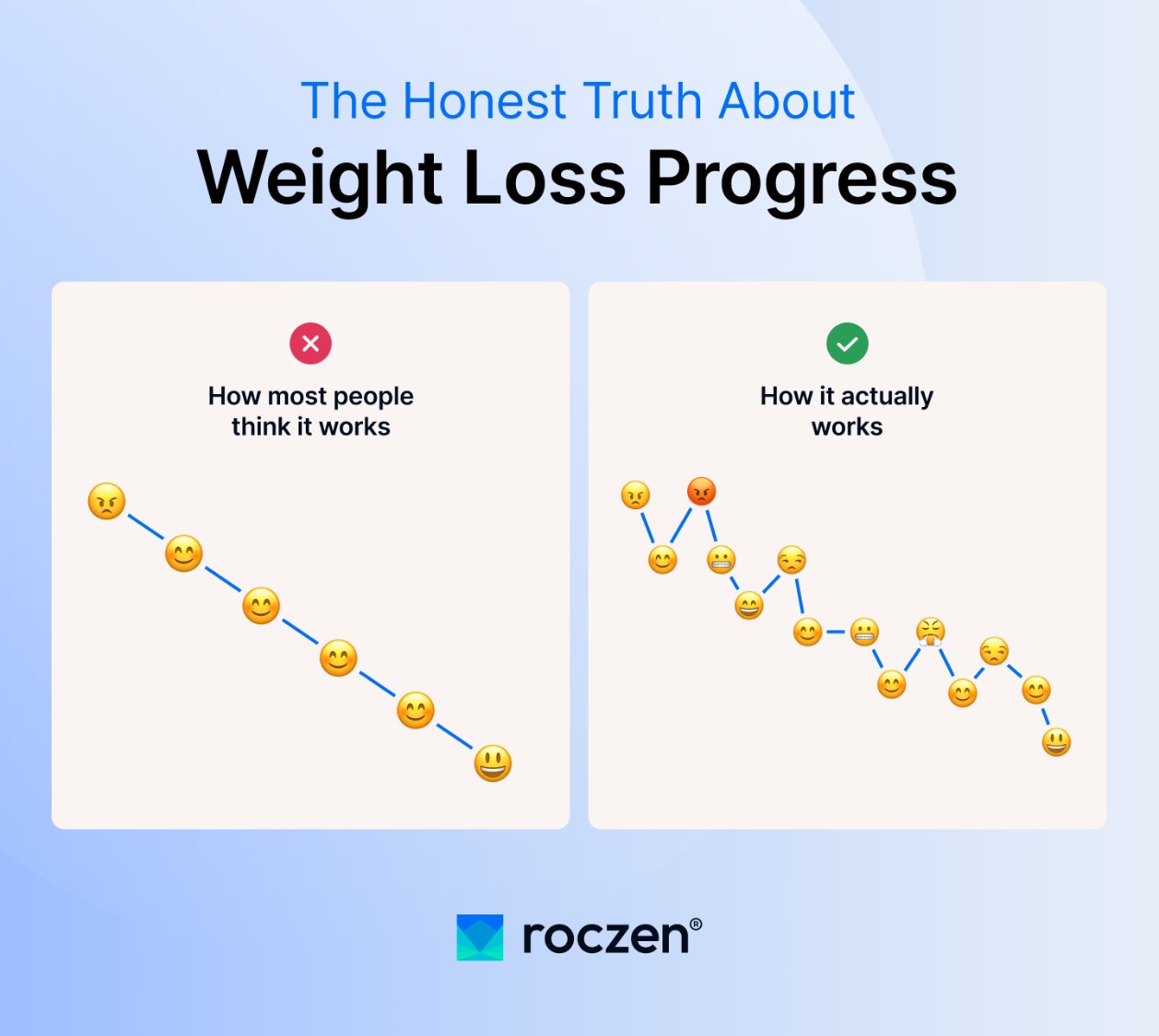
Perubahan ini kadang-kadang boleh membuat anda meragui kemajuan anda, menjejaskan perasaan emosi anda, dan menyukarkan untuk kekal konsisten dengan tabiat sihat. Itulah sebabnya panduan kami mencadangkan untuk menimbang diri pada waktu tertentu, tetapi tidak terlalu kerap. Di Roczen, kami meminta ukuran yang kerap supaya kami dapat membina gambaran tepat tentang corak berat badan jangka panjang anda dan membantu melindungi anda daripada perasaan dan tingkah laku yang tidak membantu yang boleh timbul daripada pemeriksaan terlalu kerap.
Menguruskan turun naik
Memberi tumpuan kepada matlamat berat badan jangka panjang adalah seperti maraton, bukannya larian pecut. Dengan ini, penting juga untuk diingat bahawa pengurusan berat badan tidak selalu linear.
Beberapa tip praktikal di bawah boleh menyokong anda dalam memahami ukuran dan trend berat badan:
- Pada hari menimbang, lakukan ini pada waktu yang sama setiap hari, sebaik-baiknya pada waktu pagi selepas menggunakan bilik air dan sebelum berbuka puasa atau minum untuk bacaan yang lebih tepat.
- Elakkan menimbang setiap hari jika boleh. Penimbangan mingguan atau dua minggu sekali termasuk lilitan pinggang memberikan gambaran perubahan yang lebih jelas.
- Tumpukan pada trend dari masa ke masa, bukan angka tunggal. Turun naik kecil adalah biasa dan dijangka, bersandarlah pada rangkaian sokongan anda untuk membincangkan sebarang kebimbangan.
Beri perhatian kepada tanda-tanda kemajuan lain: bagaimana pakaian anda muat, tahap tenaga, kekuatan, dan ukuran pinggang.
Kesimpulan
Turun naik berat badan harian adalah normal. Ia biasanya berpunca daripada perkara harian seperti apa yang anda makan, berapa banyak anda minum, kualiti tidur anda, dan bagaimana badan anda memproses makanan, berbanding dengan perubahan lemak badan. Memahami mengapa berat badan anda berubah sepatutnya dapat membantu meredakan kebimbangan anda dan mengekalkan jangkaan yang realistik. Jika anda mendapati peningkatan bengkak, kembung perut atau sebarang gejala yang membimbangkan, sila hubungi doktor anda.
Maklumat dalam laman web ini adalah untuk tujuan pendidikan dan makluman umum dan tidak menggantikan nasihat, diagnosis atau pelan perawatan daripada pasukan klinikal bertauliah. Anda disyorkan untuk merujuk kakitangan kesihatan bertauliah untuk mendapat panduan kesihatan peribadi.
Rujukan
- NHS. Water, drinks and nutrition [Internet]. 2025 [cited 2025 Dec 11]. Available from: https://www.nhs.uk/live-well/eat-well/food-guidelines-and-food-labels/water-drinks-nutrition/
- NHS England. Recording your weight for healthy progress [Internet]. 2025 [cited 2025 Dec 11]. Available from: https://www.england.nhs.uk/long-read/how-to-record-your-weight/
- Van Regenmortel N, Langer T, De Weerdt T, Roelant E, Malbrain M, Van den Wyngaert T, Jorens P. Effect of sodium administration on fluid balance and sodium balance in health and the perioperative setting [Internet]. Journal of Critical Care. 2022;67:157-165 [cited 2025 Dec 11]. Available from: https://www.sciencedirect.com/science/article/pii/S0883944121002458


