What We Will Cover
- What is the RPE scale?
- When and how to use the RPE scale
- How the RPE scale can build your confidence
What is the RPE scale?
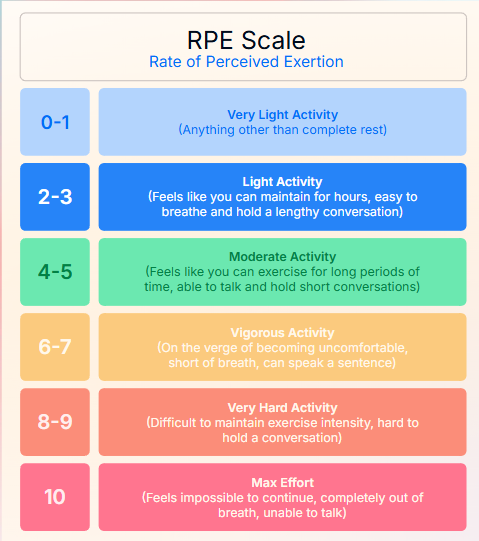
The RPE scale stands for rate of perceived exertion or “how hard does this activity feel right now”.
It’s a simple tool used in many exercise settings and instead of looking at speed, distance or calories burned - it focuses on your own experience and effort.
The scale ranges from 0 to 10, with 0 being complete rest and 10 being maximum effort.
This is a really helpful tool because everybody is different. An activity that feels easy for one person may feel much harder for someone else so there is no right or wrong score.
When and how to use the RPE scale
The RPE scale can be used during any type of activity such as: strength exercises, cycling, swimming, gardening or chair based mobility movements. It is best to use the scale at the end of each session for those doing cardio or after each set for those doing strength training.
“How hard does this activity feel right now?”. This is the question you need to ask yourself while exercising to help you decide whether to continue at the same pace or to increase/reduce the challenge.
Exercising at a moderate effort of 4 to 5 is a good starting point when aiming for a level to maintain during exercise. Here you should be breathing harder than normal but still able to hold a conversation. This links to the guidelines of 150 minutes of moderate-intensity exercise per week.
For intense exercise such as sprints or strength training, you should be looking to reach an RPE of 6 to 7 or even 8 to 9 if you feel comfortable pushing that hard. This links to the guidelines of 75 minutes of vigorous-intensity exercise per week.
An RPE level of 10 is rarely useful or even achieved unless you are doing tests specifically designed to push your body to the absolute maximum, this is not recommended without professional supervision.
Some days you may feel more energetic than others. Stress, sleep and illness can all affect how exercise feels. The RPE scale helps you adjust your activity based on how you feel on that particular day, making it easier to exercise at a level that feels manageable.
How the RPE scale can build your confidence
Starting exercise can sometimes feel confusing. You may wonder if you are working too hard or not hard enough. By regularly checking how exercise feels, you will learn to trust your body and make adjustments when needed. This can help exercise feel more manageable and enjoyable.
You may also notice that activities become easier over time. For example, a walk that once felt like a 7 out of 10 may feel like a 4 out of 10 after a few weeks. Noting and seeing this progress can help build confidence and motivate you to keep going.
This is a sign that your body has adapted, if this score remains lower for your next 3-4 sessions, it could be a good idea to increase your challenge to keep you progressing. It can also help you set realistic goals. Rather than trying to match what others are doing, you can focus on finding an effort level that works for you.
Summary
The RPE scale is a tool for finding a level that feels safe, sustainable, and suitable for your current fitness level. Please ensure that you are safe to do exercise by consulting your clinician before beginning any exercise program. If you need further support, please contact your clinician or mentor.
The information on this page is for educational purposes only and is not a substitute for professional medical advice, diagnosis, or treatment. Always consult a qualified healthcare professional for personalised medical guidance.
References
- National Academy of Sports Medicine. Rate of Perceived Exertion (RPE) Scale Explained [Internet]. NASM Blog. 2024 [cited 2026 Jun 28]. Available from: https://blog.nasm.org/rate-of-perceived-exertion
- Helms ER, Storey A, Cross MR, Brown SR, Lenetsky S, Ramsay H, et al. Application of the Repetitions in Reserve Based Rating of Perceived Exertion Scale for Resistance Training [Internet]. Strength and Conditioning Journal. 2016 [cited 2026 Jul 15]. Available from: https://www.ovid.com/jnls/nsca-scj/fulltext/10.1519/ssc.0000000000000218~application-of-the-repetitions-in-reserve-based-rating-of
- British Cycling. Related Rate of Perceived Exertion Scale (RPE) [Internet]. British Cycling. 2015 [cited 2026 Jun 28]. Available from: https://www.britishcycling.org.uk/knowledge/article/izn20151119-Training-Plans-Supporting-Documents-Related-Rate-of-Perceived-Exertion-Scale---RPE-0
- HEART UK. Exercise [Internet]. HEART UK. [cited 2026 Jun 28]. Available from: https://www.heartuk.org.uk/healthy-living/exercise


